
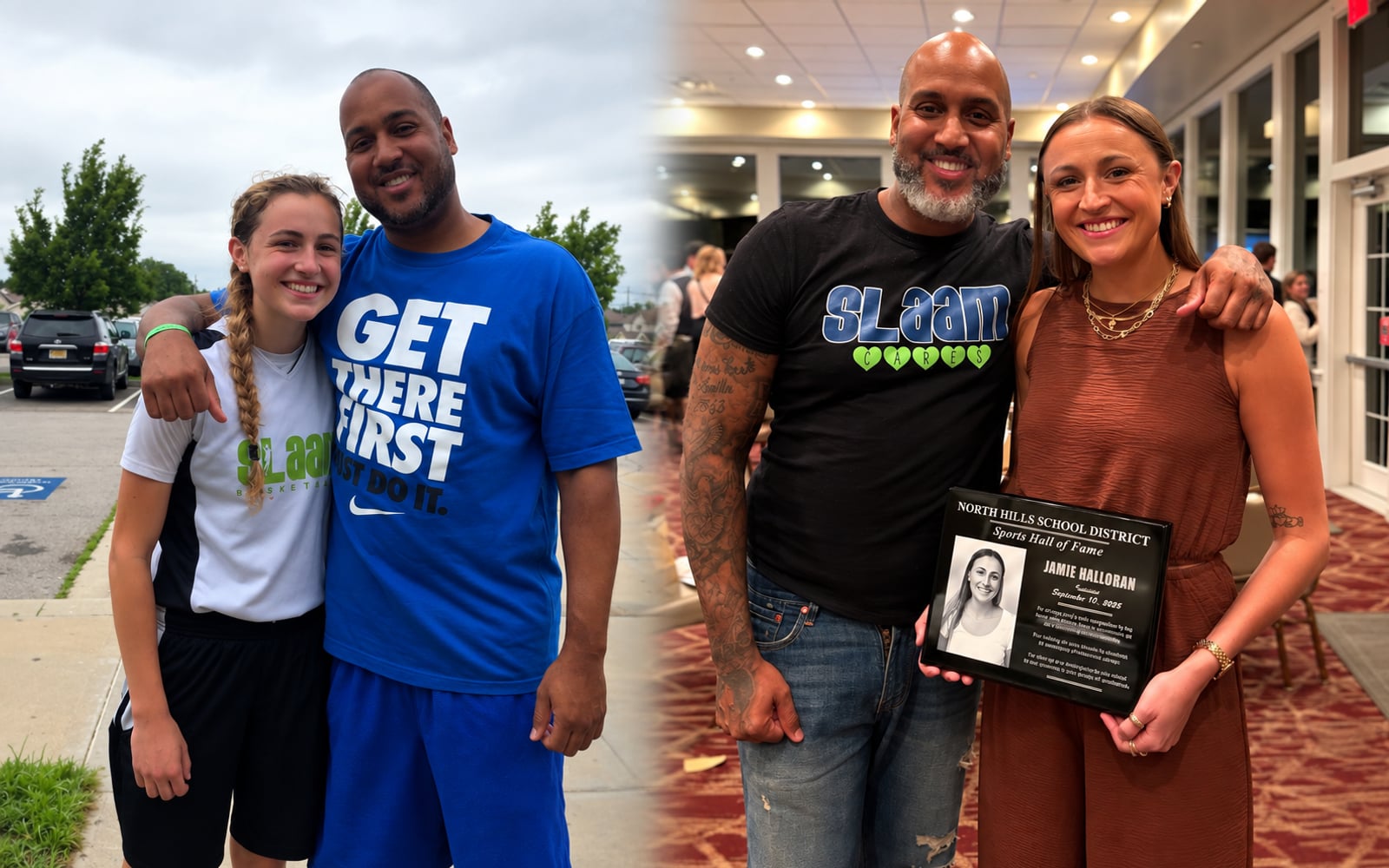
Jamie Halloran was the first SLAAM player to navigate college recruitment. A decade later, her induction into the North Hills Sports Hall of Fame reflects a journey built on confidence, perseverance and relationships that outlast the game.
Long before Jamie Halloran became a college athlete, a conference champion and a Hall of Famer, she was a gifted young player still learning to trust her own game.
At North Hills, Jamie would become a four-year starter, a two-year captain and one of the top scorers in the history of the girls basketball program. But talent and confidence did not always arrive at the same time.
One of the people who helped close that gap was Jamal Woodson.
Jamie remembers what it was like to play against Jamal before she ever played for him.
She hated it.
“He obviously is very obnoxious and yelling and stuff,” Jamie laughed. “So, hated playing against him.”
Eventually, the coach she hated competing against became her coach, her advocate and one of the most constant people in her basketball life.
Jamie joined SLAAM after her previous AAU team went in different directions, and she stayed through her junior year of high school.
Before she believed it, they did
“I definitely didn’t have a lot of confidence,” Jamie said. “That was probably my biggest hurdle that I had to overcome.”
Her parents kept pouring into her. Her dad rebounded whenever she wanted to get shots up. At SLAAM, she found another circle of people willing to challenge her while making sure she knew they believed in her.
That belief showed up most clearly when the game was on the line.
When her team desperately needed a bucket, Jamal remembers not even bothering to call a play.
“Jamie, go to work.”
Jamie knew exactly what that meant. The ball was going to her, and so was the responsibility.
“Knowing that he believed in me, even if I was playing crappy that game, he would still put that trust in me,” she said.
Those moments did more than give Jamie permission to take a shot. They helped her become the player who believed she could make it.
That part of development does not appear in a box score. It happens when a coach sees more in a player, asks more of her and stays close enough for her confidence to catch up with her ability.
The first door opens
Jamie did not seriously consider college basketball until around eighth grade. Once she understood it was possible, the recruiting process began.
She became SLAAM’s first college recruit and the first player Jamal guided through that process. He contacted schools, helped build relationships with college coaches, attended visits and stood beside Jamie when she received her first offer from Walsh University.
“I think it’s definitely rare to have someone as constant as Jamal has been in my life,” Jamie said.
Jamie ultimately accepted a full athletic scholarship to Walsh University, where she played NCAA Division II basketball from 2016 to 2020.
She was the first SLAAM player to walk through that door. Others would follow.
“Jamie will always be special to me because she was the first. I started coaching her when she was in sixth grade, and I was there all the way through her last AAU game. But those early years weren’t easy. There were a lot of tears, I was harder on Jamie than anybody else. I yelled at her in practices, I yelled at her in games, and sometimes she would cry. And when she cried, I didn’t back off, sometimes I got even tougher on her.
That wasn’t because I didn’t care about her. It was actually the opposite. I knew how special she could be, and I wasn’t going to lower the standard because things got uncomfortable. Jamie was our best player, and I’ve always believed that if you’re going to build a great team, you have to be willing to coach your best player the hardest. When everybody sees that your best player is being held accountable, nobody believes they’re above the standard.
What makes it special for me now is knowing that the sixth grade girl who sometimes left practice in tears kept coming back. She kept working. She kept growing. Eventually, the confidence started catching up with the talent that all of us already saw in her.
Then Jamie became another first for me and for SLAAM. When it came time for college recruiting, Jamie and I were learning that process together. I was calling coaches, building relationships, going on visits and figuring out what it took to help one of our players get to the next level.
Watching her earn a full scholarship and then, all these years later, watching her be inducted into the North Hills Sports Hall of Fame, that’s a full-circle moment I’ll never forget. Jamie helped establish what SLAAM was going to be about. It wasn’t just winning AAU games. It was developing young women, holding them accountable, building relationships with families, creating opportunities for their future and staying in their lives long after basketball is over.
Jamie was the first one we helped walk through that door. So many young ladies have followed her since, but somebody had to be first. For SLAAM, that was Jamie Halloran. From those tears in sixth grade to watching her become a Hall of Famer — man, I’m proud of her.”
Development is tested when it gets hard
Reaching college was an achievement. Growing through college required something more.
Jamie struggled with the transition and with playing time early in her career. She also faced mental challenges that, as she puts it, many people probably never saw.
That is when the relationships around an athlete reveal what they are really built on.
Her parents kept showing up.
Her SLAAM family kept showing up.
Jamal came to games even when Jamie was not playing much.
The support was not tied to minutes or statistics. The people who helped Jamie reach college remained invested in the person navigating it.
Jamie kept working. She earned a larger role, became a starter and helped Walsh win back-to-back conference championships in 2019 and 2020.
In what became her final college game, Walsh won the 2020 Great Midwest championship.
It was a storybook ending, but the path there had not been one. Jamie had learned how to keep going when her role changed, how to work through doubt and how to stay connected to the people who reminded her who she was.
What remains after the final buzzer
Ask Jamie about her favorite memories and she does not begin with a particular game.
She talks about traveling.
AAU weekends.
Her teammates.
The people.
“Some of the people that I played AAU with are still some of my best friends,” she said.
Years later, while living in Indianapolis, Jamie made her way back to Run for the Roses in Louisville and reconnected with SLAAM.
“The people that I’ve crossed paths with because of SLAAM is what stands out to me the most.”
Basketball remained part of Jamie’s life after her playing career ended. Today, she serves as Assistant Commissioner of the Great Midwest Athletic Conference, the same conference in which she played at Walsh.
And this September, her journey brought her all the way back home.
Jamie was inducted into the North Hills Sports Hall of Fame.
When asked what went through her mind standing there, she did not talk first about being a four year starter, scoring more than 1,000 high school points or winning championships.
She thought about her parents.
Her coaches.
Her teammates.
Her friends.
“I definitely think of all the people,” Jamie said. “I’ve met some of the best people because of just playing basketball.”
More than basketball
Jamie’s Hall of Fame induction celebrates an accomplished athlete. It also captures what families hope sports can become in a child’s life.
Her story leaves behind a path others can recognize: a young player learning confidence, parents watching the right adults invest in her and a college program receiving an athlete prepared to keep working when success was not immediate.
None of it happened in a straight line. That is what makes the story worth telling.
Years ago, Jamie was the player being told:
Jamie, go to work.
She did.
She became SLAAM’s first college recruit, a scholarship athlete, a two-time conference champion and now a Hall of Famer.
But the strongest measure of the journey may be this: the people who believed in her then are still beside her now.
“I think it’s really cool how we’re all connected just because of basketball.” — Jamie Halloran